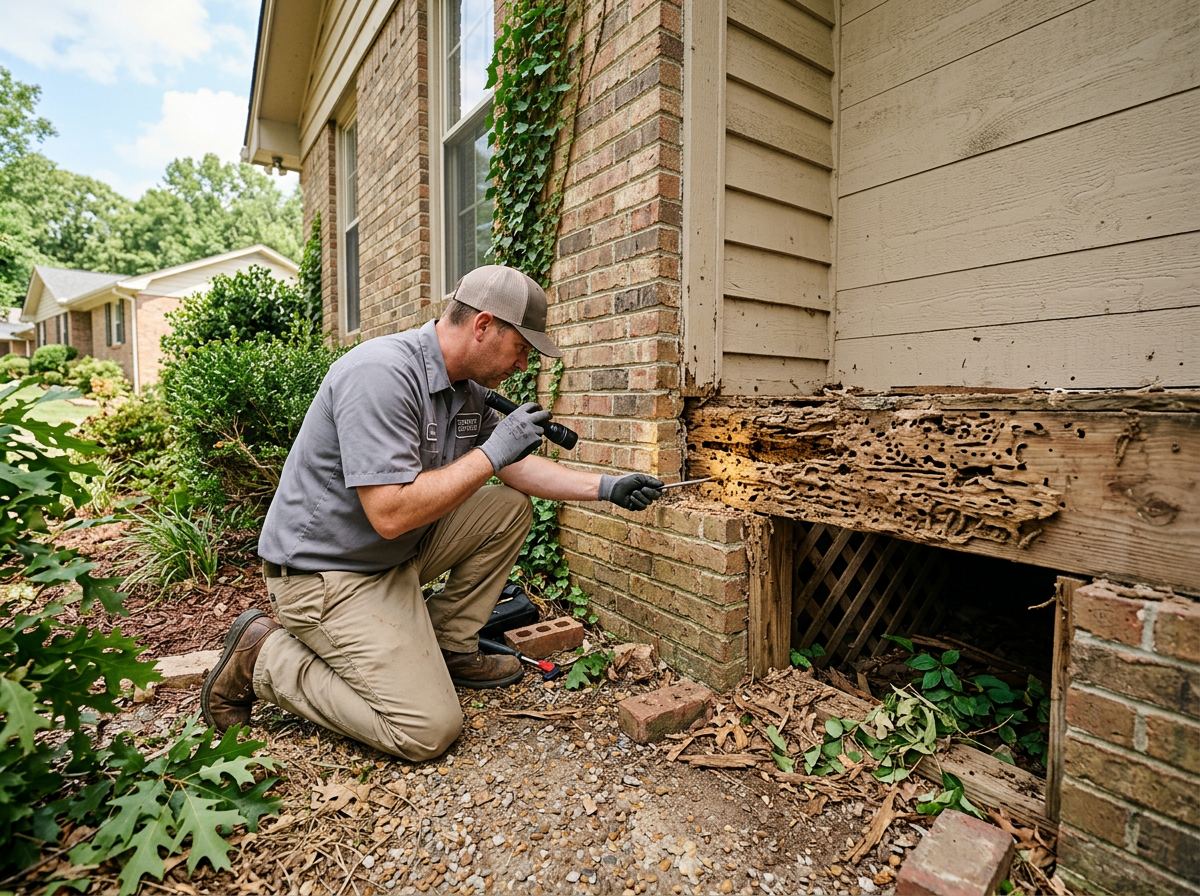
Maryville homes built between the 1960s and 1990s often feature vented crawl spaces over red clay soils that retain moisture through humid summers. Termites exploit wood-to-soil contact at sill plates and floor joists, leaving mud tubes along piers and foundation walls. Homeowners notice swarmers or discarded wings near the Blount County Courthouse area or in Eagleton Village split-levels during March through May.
Inspection starts with checking for active tunnels and probing softened wood in joists and plates. A moisture meter helps locate hidden damp zones where termites thrive beneath brick ranches in Wildwood and Alcoa. Liquid termiticide is applied through trenching around foundations and rodding under slabs or porches to reach foraging galleries without disturbing finished floors.
Ongoing monitoring with bait stations tracks colony activity after initial treatment. Vapor barriers and improved grading reduce future moisture that draws termites back to untreated wood. Pre-construction soil treatment protects new builds near Greenbelt Park from the same red clay conditions that affect older neighborhoods.
Technician insight
In Maryville the thing that catches most people out with Termite Wood Damage is how the red clay under 1960s-90s vented crawls stays damp all summer, letting termites reach sill plates without ever showing swarmers until the joists are already soft.
Eagleton Village Split-Level
Mud tubes ran along the piers of a 1970s split-level. Inspection found active galleries in several floor joists over the red clay crawl space. Trenching and rodding were completed around the perimeter with bait stations added. Follow-up checks showed no new activity.
Termite Wood Damage Services We Offer
✓Sill Plate Termite Inspection
Direct examination of sill plates in vented crawl spaces reveals early termite galleries before they spread into floor framing of Maryville ranches.
✓Floor Joist Damage Evaluation
Probing and moisture readings on floor joists identify compromised sections caused by eastern subterranean termites in Blount County homes.
✓Mud Tube Mapping and Removal
Systematic removal of mud tubes along piers and foundation walls allows tracking of active termite movement in local crawl spaces.
✓Wood-to-Soil Contact Correction
Identification of direct wood-to-soil contact points helps homeowners reduce termite entry routes common in 1960s-90s Maryville construction.
✓Slab and Porch Drilling Treatment
Targeted drilling through concrete slabs and porches delivers termiticide to hidden galleries beneath attached structures.
How it works
- 1
Crawl Space Entry and Visual Scan
Technicians enter the vented crawl space and scan piers, sill plates, and joists for mud tubes and damaged wood.
- 2
Moisture Meter Testing
Readings are taken at multiple points to locate damp areas that support termite activity in red clay soils.
- 3
Trenching and Rodding Application
Liquid termiticide is placed in trenches around the foundation and rodded beneath slabs where needed.
- 4
Bait Station Installation and Monitoring
Stations are set and checked on a schedule to confirm colony decline after the initial treatment.